Henry Jackson, an Associated Press Writer, has just reported from Des Moines, Iowa, that - two men were married outside a minister's home in the state's first legal same-sex wedding this Friday morning, less than 24 hours after a judge threw out Iowa's ban on gay marriage.
An appeal was issued and the same judge, who threw out the ban yesterday, issued a stay today. Recorder Julie Haggerty said the instruction came from the county attorney's office and no more marriage applications from gay couples could be granted until the Iowa Supreme Court rules on the county's appeal.
We pray that the will of the citizens of Iowa be respected.
May Iowa’s Supreme Court respect God’s plan for marriage and may no more judges take the law into their hands to change it!
Friday, August 31, 2007

Thursday, August 30, 2007
Bank Named TIME
Imagine that a bank credits your account each morning with $86,400. No balance is carried over from day to day. Any balance is deleted each evening. What would you do when you knew that you would not use all your daily balance? Why, withdraw every farthing, of course!!!!!!
You have such a bank and so have I. The name of our bank is TIME. Every day we are credited with 86,400 seconds. Every night, that which we have not used is debited from our account.
TIME bank allows no overdraft, there is no going back for a second chance. TIME bank does not allow borrowing from tomorrow and of course, and there are no leftovers. The clock ticks away, never waiting for sluggards to catch up, no waiting, for what might have been, relentlessly the clock ticks and ticks.
We must invest our treasure wisely so that we obtain the best return in health, success, happiness, giving freely to those in need of God’s love, the warmth of Jesus arms, the teaching of our taskmaster, The HOLY SPIRIT.
Source Unknown
Tuesday, August 28, 2007
MHR & How it Got That Way.
“Gays and Grays: The Story of the Inclusion of the Gay Community at Most Holy Redeemer Catholic Parish” by Fr. Donal Godfrey, SJ. Published by Lexington Books, 2007. Reviewed by Gibbons J. Cooney.
All quotations are from Fr. Godfrey directly, unless specified otherwise. Interpolations are in parentheses, and are for purposes of clarity/identification only.
Fr. Donal Godfrey’s book is a valuable document. It demonstrates clearly, and I believe honestly, how an originally Catholic parish became an heretical spiritual institution. Relentlessly and beyond doubt, it shows that the authentic community-forming experience at Most Holy Redeemer Parish in San Francisco is not Catholicism, but homosexuality. Existentially, Most Holy Redeemer is not a Catholic parish. It is not a Christian parish. It is a gay parish:
“When I spoke with Sr. (Cleta Harold) about entering RCIA, I was clearly not about to compromise anything regarding my sexuality. I didn’t go into a lot of details, but I showed up in my Levis and leather jacket and talked about my background as a Gay activist, clearly not about to change that…I talked about my background with witchcraft and the Sisters of Perpetual Indulgence, and my disagreements with certain points of the catechism. Sister never batted an eyelash, but asked if I could show up Sunday mornings at 8.” Jack Fertig (aka “Sister Boom Boom” of the Sisters of Perpetual Indulgence) quoted, p 42.
“So one Sunday I went to Mass, and I thought, oh my, this place is so gay. . . My older sister, she probably belongs to Opus Dei, I brought her here one time, and she wrote a letter saying that all these men who have sex with other men are going to communion. My sister said, ‘You know, it is social at MHR, and that should not be part of religion. You go there to save your soul…’ Her letter said it was her duty to tell me that I was sinning!” Charles Bold, quoted, p124.
“It started to dawn on me how gay it (MHR) was only after I started going there—you know the whole social thing, they are looking for boyfriends!” Jeff Ferris, quoted, p140.
This was to be expected when the community-forming experience of a people was the kind of genital pleasure they enjoyed. What other basis can there be for a “gay community”? And if the type of genital pleasure one enjoys is the community-forming experience of a people, it would be unheard-of for the spiritual institutions of that community not to be informed by this same experience. Fr. Godfrey says as much:
“I believe in other words, that the gospel must always be inculturated into every culture, and this must include gay culture.” p138.
"Is it less appropriate for gays to imagine Jesus as gay than for African Christians to picture him as black, Asian Christians as Asian?" p134.
Ah. Imaginary Jesus. To answer Father's question: given what "gay" means at MHR, in the surrounding neighborhood, and in the common-sense understanding of the word, namely, a man having sex with another man, yes, it is less appropriate. Father falls into a temptation that eveyone is subject to: because I am made in the image of God, and because God loves me, therefore what I am doing must be right:
"Can we hear the voice of God in the voice of this parish? MHR helped me to find my own voice..." p132.
And if what I am doing is right, then those who say something different must be wrong:
“The Catholic Church is not a credible moral voice within the gay community.” p153.
The moral credibility of the Catholic Church, then, will be determined by the extent to which it supports, or fails to support, the community-forming experience of the gay community. If, as I argue, the sexuality is experienced as more important than the doctrines of the Catholic Church, one would expect the doctrines of the Church to be discarded when they come into conflict with the community-forming experience. And this is exactly what happens:
“(Rev. Jim) Mitsulki (of Metropolitan Community Church) has very fond memories of ‘Fr. Tony’ (McGuire)…Mitsulki speaks of a certain revolving-door factor operating between their respective congregations. Some attended services at both churches . . . Sometimes parishioners from Most Holy Redeemer went to MCC for same-sex weddings they could not hold at MHR.” p54. (see footnote 1).
“Well the question in my mind was, the people who make a conscientious decision to live together as a gay couple, and then they come to communion, just like people who make a similar decision on birth control, you don’t harass them. You respect their decision. The next step was, ‘Can a clearly gay couple take on open ministries in the church?’ Like if a gay couple apply for ordination, that would clearly be an obex. What about Eucharistic Ministers? I thought maybe I should consult [Archbishop Quinn], but then we already had them!” Fr. Anthony McGuire, quoted p52. (Emphasis added; see footnotes 2 & 3)
And the doctrines will not only be discarded, but mocked:
“(Pastor Anthony) McGuire used his marvelous sense of humor to touch his flock’s imaginations and to lubricate tense situations. His humor was even on display at his final Mass of Thanksgiving in the parish. In his homily he deadpanned that when he first arrived in the parish, he just though ‘Hail Holy Queen’ was a good entrance hymn! This line was captured on tape in a television news story about McGuire’s leaving the Castro. Of course, the entire assembly broke into laughter.” p34.
“When a former Catholic asked McGuire if his AA group might use the hall for a Halloween party, McGuire thought it sounded like a very appropriate request. When he said yes, he had no idea everyone would turn up either in drag or wearing practically nothing! The next day the woman who, in his words, was ‘the second most uptight parishioner,’ called and was furious. She berated him over the impropriety of such goings-on on church property. “It was like Sodom and Gomorrah!’ she thundered. To which McGuire answered meekly, with his mischievous humor, ‘Well, maybe Sodom’.” p36. (Emphasis added).
And this leads to the acceptance of blasphemy in an ostensibly Catholic Church. But such events will not be experienced by the parishioners as blasphemous, because they validate the community-forming experience:
“One of the most colorful members of the (MHR’s Gay and Lesbian Outreach) committee was simply known to everyone as Pansy…Pansy Bradshaw helped to write a definitive guide to San Francisco . . . ‘Betty and Pansy’s Severe Queer Review of San Francisco: An irreverent opinionated guide to the bars, clubs, restaurants, cruising areas, performing arts, and other attractions of the queer Mecca.’ Most Holy Redeemer was reviewed positively in the early editions; more recently, the parish is simply listed along with other ‘queer-positive religious organizations and churches.’” Footnote 14, p58. (Emphasis added; see footnote 4).
“The baptism of children being raised by gay couples took place publicly at the 10AM Sunday liturgy…One gay couple, Dan McPherson and Kevin Gogin, active MHR parishioners while McGuire was pastor, did adopt a daughter, Sarah, in 1998, but she was quietly baptized outside the parish at St. Ignatius Church. . . .Rob Lane & Don Propstra’s adopted son was baptized at a regular liturgy in the parish on October 21, 1990 . . . “Kevin and Dan [Gogin and McPherson] were the godparents.” p103-104 (see footnote 5)
“MHR itself has marched as a parish in the San Francisco Gay Freedom/Gay Pride Day parade since 1998.” p112. (see footnote 6)
“But it was a first for a Catholic parish (emph. orig.) in San Francisco. Parishioners who marched were unsure what to expect, some expected the worst, but found themselves moved by the overwhelming response of the crowd. Since 1998, taking part in the Pride Parade has become an MHR tradition. (Fr. Zachary) Shore’s semi-tacit sanctioning of a parish presence in the parade lent the Church’s legitimacy to this event of the gay community…” p112. (Emphasis in final sentence added).
“On (Gay Pride) parade day, June 25, 2005, Fr. Tom Hayes celebrated the 8:00AM Mass. He asked parishioners to join him in a special blessing for those who would be marching that morning. Then, with his typical wit, he exhorted those marching to make sure they gave a special blessing with a sign of the cross to the television cameras…: “You never know who may be watching you.” p114.
“Fr. Randy Calvo (now Bishop of Reno) remembers the tension in the church at that midnight Mass: At the beginning of the service someone started screaming—but he turned out to be ‘one of our own crazies: Charles. A former Cistercian, who hung around the parish. Well, there was a great deal of relief once we identified it as one of our own crazies.’… Since that Christmas, MHR and the Sisters of Perpetual Indulgence have continued to interact from time to time.” p40 (see footnote 7).
Indeed, at this point, what will be experienced by the parishioners as blasphemous is that which denies the value of the community-forming experience:
“One of the first encounters I had was with Jim Stultz, President of the parish council at the time. He came to me and said I’d like to interview you before you get to the parish . . . I remember one thing he talked about. He criticized someone who gave a homily at MHR bashing people for going to the gay baths, and all that.” Fr. Randolph Calvo (now Bishop of Reno, Nevada), quoted p48. (see footnote 8)
“Dear Archbishop,
A week ago Friday, October 15, I was appalled to see the headlines of the San Francisco Examiner read ‘Catholics antigay Funds.’ As a priest of the Archdiocese of San Francisco and Pastor of Most Holy Redeemer Church, I cannot accept the decision of the Bishops of California to allocate financial assistance to Senator Knight’s Protection of Marriage Committee.” (Proposition 22, which defined marriage as between a man and a woman). Letter from Fr. Zachary Shore to Archbishop William Levada. p115. (see footnote 9)
“The institutional Church is blind, ‘just doesn’t get it,’ in the same way Jesus was initially blind and didn’t get it with the Canaanite woman. A parish such as MHR calls the rest of the institution to conversion…” p130.
There’s a word for this: heresy. For all I know, this heresy already has a name and has been catalogued. This particular heresy is probably not limited to homosexuality. The flowering of what is now called “identity politics” began in the 1960s; the “Gay Rights” movement grew out of that; and its extension into spiritual institutions I have detailed briefly above. I sense similarities between this and the rise of “national consciousness” that was a one of the impulses in the “Reformation.” Just what it is in our time that provokes people to define themselves in such strange and limited ways would be an interesting project for a real historical scholar.
The parishioners of Most Holy Redeemer are wrong but they should not be overly faulted. Most Holy Redeemer is indeed the expression of a genuine spirituality. Their church is not a Catholic Church, in any sense (Catholic meaning universal, and a spirituality based on the disordered sexual desire of 2-5% of the population is anything but universal), but Fr. Godfrey quite openly states that, when he says: “The Catholic Church is not a credible moral voice within the gay community.”
The fault lies squarely with the Archdiocese of San Francisco, which, as detailed in Fr. Godfrey’s book, allowed a Catholic parish to turn into an heretical spiritual institution:
“‘They came from the chancery, the personnel board, to ask questions, to see whom to send. We have to replace Fr. Moriarity, they said; ‘What kind of pastor do we need in this parish?’ I said, ‘The parish is gradually becoming more gay. These are the demographics of the area. This needs to be thought about in making this decision.’ There was absolute stone-dead silence in the room. . and the meeting went on to another point.’" Deacon Laurence Rolle, quoted, p27.
“Fortunately, Archbishop John Quinn was well aware the question needed to be asked, and chose a man who turned out to be especially suited to the new sociological profile of the parish. Under Father Anthony McGuire—‘Fr. Tony—the parish was reborn…. Anthony McGuire became the ninth pastor of Most Holy Redeemer parish in 1982.” p27.
“The two gay men (on the MHR advisory board) suggested we start a gay and lesbian outreach. And that was approved 12 to nothing.” p29.
“The Gay and Lesbian outreach Committee—so unique, so bracing, so critically what the parish needed when it needed it—eventually withered away, a victim of its own success, when the entire parish had taken on the work it was formed to begin.” (Emphasis added) p29.
“When the entire parish had taken on the work it was formed to begin.” There’s a frightening provincialism in “modern man” and Churchmen are not immune. Some no longer believe that “heresy” is a concept that refers to anything real, or, if it does, it refers to something that arose in conditions of ignorance, in the bad old days, and that now, with enlightened types like us around, everything is amenable to rational argument. At his installation, our current Archbishop, George Niederauer, quoted from T.S. Eliot’s poem “The Rock.” He could have quoted these lines from the same poem, but didn’t:
Do you think that the Faith has conquered the World
And that lions no longer need keepers?
Do you need to be told that whatever has been, can still be?
But homosexuality as a community-forming experience is not an idea that one can be argued out of, because it is not an idea at all. It is an experienced reality. It can, however, be transcended—those suffering from this condition must become part of the larger experience of following Christ, wherever he may lead, in chastity. But “how can they hear without someone to preach?” (Romans 10:15)
Aside from the “Courage” Apostolate (for which one looks in vain on the website of the Archdiocese of San Francisco), where is the support? It certainly is not coming from Fr. Godfrey. He says: “that the gospel must always be inculturated into every culture, and this must include gay culture”; his book shows that in practice this has meant imposing “gay culture” into the Gospel. Nor is there any support from the Archdiocese of San Francisco. Their neglect of the spiritual welfare of the parishioners at Most Holy Redeemer, and of gay people throughout the Archdiocese, is clerical malpractice.
But that is the reason Catholics should be thankful for Fr. Godfrey’s book. It is an unmistakable challenge to the leaders of our Archdiocese, indeed to Rome, and it puts them on the spot.
"I will not feign academic objectivity: if such a thing really exists. I firmly believe in a new approach and a new vision in this area of ministry. In this I do have an 'agenda.'" p132.
How will they respond? Will they take up the challenge, ignore it, or do they agree with Fr. Godfrey?
Actually, ignoring equals agreement: on August 1, 2007, Fr. Donal Godfrey was appointed Executive Director of Campus Ministry at the (Jesuit) University of San Francisco.
Actually, ignoring equals agreement: on August 1, 2007, Fr. Donal Godfrey was appointed Executive Director of Campus Ministry at the (Jesuit) University of San Francisco.
Notes:
1. “The Metropolitan Community Church (in full, The Universal Fellowship of Metropolitan Community Churches or UFMCC, or more commonly MCC) is an international fellowship of Christian congregations. It is considered by many to be a liberal mainline denomination or communion. There are currently 250 member congregations in 23 countries, and the Fellowship has a specific outreach to lesbian, gay, bisexual, and transgender communities”.-www.wikipedia.org
2. “Obex: Any obstacle in the recipient that would prevent a sacrament from producing the supernatural effect for which the sacrament was instituted. These obstacles are mainly a lack of faith, or of the state of grace, or of a worthy intention. (Etym. Latin obex, bolt, bar, barrier; from obicere, to throw against.)” -Modern Catholic Dictionary, Fr. John Hardon.
3. “The lay Christian faithful called to give assistance at liturgical celebrations should be well instructed and must be those whose Christian life, morals and fidelity to the Church’s Magisterium recommend them.”- #46, Redemptionis Sacramentum: On certain matters to be observed or to be avoided regarding the Most Holy Eucharist. Francis Cardinal Arinze, Congregation for Divine Worship, 2004.
4. “Cruising for sex, or more commonly, cruising, denotes the act of walking or driving about a locality in search or pursuit of a suitable partner for sex, usually of the anonymous, casual, one-time variety.”-www.wikipedia.org
5. Among the requirements for a baptismal sponsor under Canon 874, #1, of the present Code of Canon Law are: the person must “live(s) a life of faith which befits the role to be undertaken,” and “When there are two godparents, they need to be a man and a woman so that the newly baptized will have a role model for each gender.”
6. Gay people of my acquaintance have referred to the gay pride parade as “nothing more than an excuse for bad behavior.” To see what they mean, click here. Caution: obscenity alert.
7. For an example of the activities of the “Sisters of Perpetual Indulgence,” go here.
8. Apart from the sinfulness of the fornication that takes place in the “gay baths,” every reputable Public Health official considered them primary vectors in the spread of HIV, and worked hard to have them closed. See here.
9. For the statement of the Congregation for the Doctrine of the Faith on Same-Sex “Marriage”, go here.
Monday, August 27, 2007
Day of Retreat
Sunday night I flew down to Los Angeles to be at Bishop Mora Salesian High School, where I was the first principal fifty years ago. I was invited to give a day of retreat for the incoming freshman students, all boys, and found it a wonderful exercise of priestly, Salesian ministry. I gave three talks: 1) the story of the school's founding; 2) who is Don Bosco? 3) a homily at Mass , and heard some confessions and got back to Richmond about 24 hours later--this Monday night, in fact.
The mentoring done by some senior students was a powerful example of the strong leading the weak and before the day was over the freshmen had learned to cheer with vim and vigor, to sing the hymns at Mass including the song to St. John Bosco, and to pray with attentive devotion. Don Bosco would be proud of these young men of East Los Angeles. I sure was.
I took to heart these words of Pope Benedict recently spoken to a group of young people at the Vatican:
"Do not cease to cultivate your own personal encounter with Christ, to keep him ever at the centre of your heart, since in this way your life will be converted into a mission; you will let Christ who lives in you shine forth.
"As young people, you are on the verge of deciding on your future. Are you doing so in the light of Christ, asking him, "What do you want of me?" Are you following the path he points out to you with generosity and confidence, knowing that as baptized people we are all, without exception, called to holiness and to be living members of the Church on whatever path we take in life?"
Sunday, August 26, 2007
Historian’s Rule: Any event, once it has occurred, can be made to appear inevitable by a competent historian.
• Wolf’s Law: Those who don’t study the past will repeat its errors. Those who do study it will find other ways to err. - Charles Wolf, Jr.
Lee Simonson, quoted by Herbert Prochnow in the Public Speaker’s Treasure Chest
• Wolf’s Law: Those who don’t study the past will repeat its errors. Those who do study it will find other ways to err. - Charles Wolf, Jr.
Lee Simonson, quoted by Herbert Prochnow in the Public Speaker’s Treasure Chest
Root of All Evil
There have always been problems for the people of God. The Bible is full of stories about victims and abuse of victims, about death and destruction, about exploitation and envy and jealousy and deceit and on and on…The problems facing our Catholic Church now is not just the horrors of sexual abuse and a world that wants no part of God, a new problem getting media attention is financial abuse. Sad stores of monies stolen from Church treasuries around the world. Greed is all too common in our “me, first” society.
Sex and financial abuse have always been part of our fallen nature, but with the media spot light, this knowledge of evil is making headlines and coming to the attention of millions.
Currently the Diocese of Cleveland is facing hard question in a civil trial concerning funds misspent to the tune of millions of dollars. The Archdiocese of San Francisco has gone though this purgatory of financial mismanagement some years ago and learned the hard way. But the warning was heeded.
I admire the way in which the Archdiocese of San Francisco oversees its financial assets. When I first became pastor at SS Peter and Paul, the parish books were scrutinized by a team of accountants. Annually, of course, an account, which covers governance as well and finance, is given to the Archbishop’s office. But now every three years the financial accounts are subject to an extensive in house audit and all the details of administration are carefully checked to see that all is in order with the laws of the land and of the church. For me, as pastor, this was a great blessing (albeit costly); for it guarantees that my parish and all of our parishes of the City are shepherded also along monetary and civil matters.
Saturday, August 25, 2007
Dogs & Life
Our football quarterback star Vick has come to hard times.
What a fracas the public and press is making over his treatment of dogs!
I love animals and I, too, was disturbed at the way the non performing fighting dogs were so brutally killed. The outrage was merited. Punishment is called for the crime against animal life.
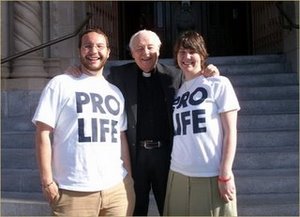
However, where is the outrage at the crimes against human life?
For 34 years, since Roe vs. Wade, a few Supreme Court justices have condemned to death without trial 45 million babies, just because they were not wanted.
The high court did state that if personhood is established (for the fetus), the appellant's case collapses, that is the right to life would be guaranteed by the 14th amendment.
It is absolutely necessary that a Life at Conception Act be passed by our Congress so that unborn children be declared persons as defined by the 14th Amendment and thus be entitled to legal protection.
Congressman Steve King and the National Pro-Life Alliance are urging citizens to contact their congress representatives and ask them to support such an Act.
You can help:
National Pro-Life Alliance
4521 Windsor Arms Court
Annandale, VA 22003
Friday, August 24, 2007
Thursday, August 23, 2007
Catholics in the Public Square
A note from the report of Father John Flynn, L.C., writing in Zenit from Rome last month:
A series of recommendations over religion's role in politics came last year in the form of a question-and-answer booklet authored by the Bishop Thomas Olmsted of Phoenix, Arizona. In his pamphlet, "Catholics in the Public Square," published by Basilica Press, he recommends the faithful to be respectful of the beliefs of others, or of those who have no faith.
At the same time, however, "Catholics should not be afraid to embrace their identity or to put their faith into practice in public life."
The Church, Bishop Olmsted continues, does not seek to impose its doctrine on others. It is, nevertheless, legitimately concerned about the common good, the promotion of justice and the welfare of society.
There is, unfortunately, he observes, discrimination against people of faith, and especially Catholics when they express their views in public debates. Not only is there misrepresentation of what Catholic view are, but there is also outright hostility to people of any faith.
"Nonetheless, it is our duty to engage the culture, not run from it," Bishop Olmsted comments. People of faith, like others, have every right to bring their views and beliefs into public.
Basic values
Another recent contribution to the theme of religion's role in politics came from Washington Archbishop Donald Wuerl. On April 13 he spoke at the National Catholic Prayer Breakfast.
In recent years there has been a weakening of support in public opinion for the role of basic religious values as a support for laws and public policy, the archbishop commented. Instead of values that are common to many faiths there are increasing calls for purely secular justifications of governmental policy.
Archbishop Wuerl argued that this tendency is contrary to the prevailing views of America's founders. There is one common principle in the American political experience, he maintained: "The belief in the binding character of moral law is fundamental to any understanding of American thought."
Catholic thought is in agreement, the archbishop continued. He noted that the Catechism of the Catholic Church speaks of the importance of the natural moral law and how the commandments are privileged expressions of the natural law.
"Religious faith has played and continues to play a significant role in promoting social justice issues as it does in defending all innocent human life," the archbishop explained. Faith, he added, helps us to see our life and to judge right and wrong according to God's wisdom.
Subscribe to:
Posts (Atom)