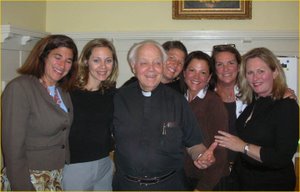
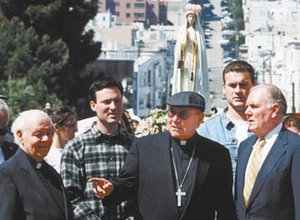
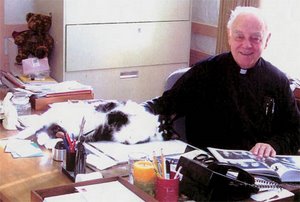
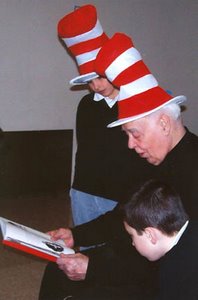
Jim Graves at Catholic World Report has a nice interview with Fr. Joseph Illo, who will head the new Oratory of St. Philip Neri in San Francisco. Here's an excerpt:
CWR: What is your plan for the new San Francisco Oratory of St.Philip Neri?
Fr. Illo: It is our hope to establish it as a community for secular priests, living in community, with a common prayer life and a common rule of life. It will support the work of priests called to work in parishes.
We hope it will be one solution to the problem of priests living in isolation, which has become a deepening difficulty in the Church. Even in a rectory with multiple priests, they can be like ships passing in the night, with little contact with one another and no common prayer life. This is an issue that bishops and diocesan personnel boards speak about all the time. I served as a vocations director for four years, and this was a big concern among men considering the priesthood. They were afraid if they gave up wife and family, they’d be lonely and isolated.
A priest in this situation has little or no accountability. Take the case of Father John Corapi. Although he was in a religious community, he lived on his own, and he got into trouble. A good prayer life is essential to the well-being of a priest; if he prays regularly, he is protected from many evils.
A priest needs support, and he needs to be kept accountable. There are many ways to do this, the oratory being one of them. There are many oratories throughout the world today, and many oratorians. [Bl.] John Henry Newman was famous for bringing the oratory to England in 1848. Today, there is still a large oratory in England, and another in Toronto. In the United States, you can find them in places like St. Louis and Cincinnati; I’ve been in touch with one in Lewiston, Maine, the Fraternity of St. Philip Neri. They have a wonderful life together and do much good work in their diocese.
Mr. Graves also gives this heartening description of Fr. Illo, which reminds me of our dear departed Fr. Malloy:
"Known for his outspoken fidelity to Catholic teaching, Fr. Illo made the news when he wrote his parishioners in 2008, “If you are one of the 54 percent of Catholics who voted for a pro-abortion candidate, you were clear on his position, and you knew the gravity of the question, I urge you to go to confession before receiving Communion.”
Praise God!
Valerie Schmalz, at Catholic San Francisco, the newspaper of the Archdiocese of San Francisco, also has a good article on the Oratory. Check it out here.
Friday, May 30, 2014

Monday, May 19, 2014
Fr. Joseph Illo's Farewell to Thomas Aquinas College
In August, Father Joseph Illo will come to San Francisco, to lead the new Oratory of St. Philip Neri. The Oratory will be at Star of the Sea Church, at 8th Avenue and Geary Boulevard. In the post below, Fr. Illo gives a hint as to the role of the Oratory.
The change is bittersweet, as are many things in life. Fr. Illo's coming to San Francisco means leaving his flock, the students of Thomas Aquinas College in Santa Paul, CA. From his blog:
Thank you for coming to say good-bye to someone who was with you only briefly. It’s a good reason to have a barbecue—many thanks to the cooks!
Briefly indeed—I hardly got to know you, but what I did get to know has been with a Tolkienesque affection and reverence. I feel like Bilbo at his eleventy-first birthday speech, but I won’t repeat his cryptically ambivalent modalism on that occasion (something about not knowing half of you half as much as I’d want). It’s been brief—I had intended to be at TAC for 3 years, but Archbishop Cordileone asked if we could get moving on the San Francisco Oratory this year. “Are you bound by contract with TAC?” he asked me last year. “Just bound by fraternal charity,” I told him, “and there’s lots of that here in Santa Paula.”In fact, I discovered “love” right away at TAC. I had interviewed with several other Catholic colleges, all of whom offered me chaplaincy positions, but only TAC offered me a job with these words: “We love you father, and we hope you will take this position.” So devastatingly disarming—you might guess that our esteemed Dean uttered those words, so characteristic of our beloved Dr. Kelley.
My Dad was a college professor, and I’ve always wanted to be a college professor. I was on my way to becoming one when I sensed a call to the priesthood, so I switched from literature to theology. But these two years have been a kind of dreamy sabbatical between parish assignments, at least living with college professors and strolling through breezy quadrangles between classes.
TAC is all about truth, but even more obviously for brief sojourners like me, the College manifests beauty. The afternoon sun on Santa Paula Ridge, for example; the morning sun that first touches the Topa Topa bluffs; young voices ringing out the glory of God in a perfectly-proportioned chapel; students sprawled under spreading oak trees with Plato and Aquinas, or playing soccer on broad green swards; spirited Shakespeare plays and Gilbert and Sullivan operettas somehow rehearsed to near-perfection alongside ambitious academic loads.
I hope the San Francisco Oratory will be counted among TAC’s many friends and supporters for years to come. I hope we can send students to you, and you can send an occasional “discerning young man” to us (if he can escape the titanic forces emanating from TAC’s lovely females). Much good work has already been accomplished at the future Oratory parish in San Francisco: a healthy elementary school and the Latin Mass every day. It is close to a few universities and Archbishop Cordileone has indicated we put particular energy into youth and young adults, as is consistent with the charism of St. Philip Neri. I thank you for affording me a brief stay with you; I ask your prayers for our fledgling Oratory of priests in SF, and assure you of ours.
Thursday, May 15, 2014
California: "Mother" and "Father" Too Discriminatory

Here's a recent example, from Breitbart News:
"In the most recent California effort to 'modernize' family convention, the state Assembly on Thursday passed AB 1951, a new bill that would allow all California parents to list themselves as 'mother,' 'father,' or 'parent' of a child in order to reflect same-sex marriages, according to a report from the Associated Press.
The bill passed by a vote of 51-13, with several Republicans voting in favor. No Republicans spoke in opposition."
Equality California describes the bill as "...allowing parents to choose to self-designate as 'father,' 'mother' or 'parent, eliminating inaccurate designations and confusion for same-sex parents."
We see the wholesale lying required to maintain the fantasy world:"eliminating inaccurate designations and confusion" when the truth is the precise opposite. Also the Satanic attempt to dominate reality:"Self-designate." And of course, while the adults in these households fool themselves, the children will see through it soon enough.
Monday, May 5, 2014
CDF Cracks Down on LCWR
And about time. Fr. Z reports that the Congregation for the Doctrine of the Faith has laid the smackdown on the Leadership Conference of Women Religious.
The letter, from Cardinal Gerhard Muller, is excellent. We have reproduced it in full. All emphases are ours. Today, there are in the Church groups of people whose highest synthesizing orientation is not Catholicism--as his Eminence says, in the context of the LCWR, "religious moving beyond the Church or even beyond Jesus." We discussed exactly this attitude (or tried to) in our 2007 review of Fr. Donal Godfrey's book Gays and Grays.
Meeting of the Superiors of the Congregation for the Doctrine of the Faith
with the Presidency of the Leadership Conference of Women Religious(LCWR)
April 30, 2014
Opening Remarks
By Cardinal Gerhard Müller
I am happy to welcome once again the Presidency of the LCWR to Rome and to the Congregation. It is a happy occasion that your visit coincides with the Canonization of Pope John Paul II and Pope John XXIII, two great figures important for the Church in our times. I am grateful as well for the presence and participation of the Delegate for the implementation of the LCWR Doctrinal Assessment, Archbishop Peter Sartain.
As in past meetings, I would like to begin by making some introductory observations which I believe will be a helpful way of framing our discussion.
First, I would like to acknowledge with gratitude the progress that has been made in the implementation of the Doctrinal Assessment. Archbishop Sartain has kept the Congregation appraised on the work regarding the revision of the LCWR Statutes and civil by-laws. We are glad to see that work continue and remain particularly interested that these foundational documents reflect more explicitly the mission of a Conference of Major Superiors as something centered on Jesus Christ and grounded in the Church’s teaching about Consecrated Life. For that collaboration, I thank you.
Two further introductory comments I would like to frame around what could be called objections to the Doctrinal Assessment raised by your predecessors during past meetings here at the Congregation and in public statements by LCWR officers. We are aware that, from the beginning, LCWR Officers judged the Doctrinal Assessment to be “flawed and the findings based on unsubstantiated accusations” and that the so-called “sanctions” were “disproportionate to the concerns raised and compromised the organization’s ability to fulfill its mission.” This principal objection, I note, was repeated most recently in the preface of the collection of LCWR Presidential Addresses you have just published. It is my intention in discussing these things frankly and openly with you to offer an explanation of why it is that we believe the conclusions of the Doctrinal Assessment are accurate and the path of reform it lays before the LCWR remains necessary so that religious life might continue to flourish in the United States.
Let me begin with the notion of “disproportionate sanctions.” One of the more contentious aspects of the Mandate—though one that has not yet been put into force—is the provision that speakers and presenters at major programs will be subject to approval by the Delegate. This provision has been portrayed as heavy-handed interference in the day-to-day activities of the Conference. For its part, the Holy See would not understand this as a “sanction,” but rather as a point of dialogue and discernment. It allows the Holy See’s Delegate to be involved in the discussion first of all in order to avoid difficult and embarrassing situations wherein speakers use an LCWR forum to advance positions at odds with the teaching of the Church. Further, this is meant as an assistance to you, the Presidency, so as to anticipate better the issues that will further complicate the relationship of the LCWR with the Holy See.
An example may help at this point. It saddens me to learn that you have decided to give the Outstanding Leadership Award during this year’s Assembly to a theologian criticized by the Bishops of the United States because of the gravity of the doctrinal errors in that theologian’s writings. This is a decision that will be seen as a rather open provocation against the Holy See and the Doctrinal Assessment. Not only that, but it further alienates the LCWR from the Bishops as well.
I realize I am speaking rather bluntly about this, but I do so out of an awareness that there is no other interpretive lens, within and outside the Church, through which the decision to confer this honor will be viewed. It is my understanding that Archbishop Sartain was informed of the selection of the honoree only after the decision had been made. Had he been involved in the conversation as the Mandate envisions, I am confident that he would have added an important element to the discernment which then may have gone in a different direction. The decision taken by the LCWR during the ongoing implementation of the Doctrinal Assessment is indeed regrettable and demonstrates clearly the necessity of the Mandate’s provision that speakers and presenters at major programs will be subject to approval by the Delegate. I must therefore inform you that this provision is to be considered fully in force. I do understand that the selection of honorees results from a process, but this case suggests that the process is itself in need of reexamination. I also understand that plans for this year’s Assembly are already at a very advanced stage and I do not see the need to interrupt them. However, following the August Assembly, it will be the expectation of the Holy See that Archbishop Sartain have an active role in the discussion about invited speakers and honorees.
Let me address a second objection, namely that the findings of the Doctrinal Assessment are unsubstantiated. The phrase in the Doctrinal Assessment most often cited as overreaching or unsubstantiated is when it talks about religious moving beyond the Church or even beyond Jesus. Yes, this is hard language and I can imagine it sounded harsh in the ears of thousands of faithful religious. I regret that, because the last thing in the world the Congregation would want to do is call into question the eloquent, even prophetic witness of so many faithful religious women. And yet, the issues raised in the Assessment are so central and so foundational, there is no other way of discussing them except as constituting a movement away from the ecclesial center of faith in Christ Jesus the Lord.
For the last several years, the Congregation has been following with increasing concern a focalizing of attention within the LCWR around the concept of Conscious Evolution. Since Barbara Marx Hubbard addressed the Assembly on this topic two years ago, every issue of your newsletter has discussed Conscious Evolution in some way. Issues of Occasional Papers have been devoted to it. We have even seen some religious Institutes modify their directional statements to incorporate concepts and undeveloped terms from Conscious Evolution.
Again, I apologize if this seems blunt, but what I must say is too important to dress up in flowery language. The fundamental theses of Conscious Evolution are opposed to Christian Revelation and, when taken unreflectively, lead almost necessarily to fundamental errors regarding the omnipotence of God, the Incarnation of Christ, the reality of Original Sin, the necessity of salvation and the definitive nature of the salvific action of Christ in the Paschal Mystery.
My concern is whether such an intense focus on new ideas such as Conscious Evolution has robbed religious of the ability truly to sentire cum Ecclesia. To phrase it as a question, do the many religious listening to addresses on this topic or reading expositions of it even hear the divergences from the Christian faith present?
This concern is even deeper than the Doctrinal Assessment’s criticism of the LCWR for not providing a counter-point during presentations and Assemblies when speakers diverge from Church teaching. The Assessment is concerned with positive errors of doctrine seen in the light of the LCWR’s responsibility to support a vision of religious life in harmony with that of the Church and to promote a solid doctrinal basis for religious life. I am worried that the uncritical acceptance of things such as Conscious Evolution seemingly without any awareness that it offers a vision of God, the cosmos, and the human person divergent from or opposed to Revelation evidences that a de facto movement beyond the Church and sound Christian faith has already occurred.
I do not think I overstate the point when I say that the futuristic ideas advanced by the proponents of Conscious Evolution are not actually new. The Gnostic tradition is filled with similar affirmations and we have seen again and again in the history of the Church the tragic results of partaking of this bitter fruit. Conscious Evolution does not offer anything which will nourish religious life as a privileged and prophetic witness rooted in Christ revealing divine love to a wounded world. It does not present the treasure beyond price for which new generations of young women will leave all to follow Christ. The Gospel does! Selfless service to the poor and marginalized in the name of Jesus Christ does!
It is in this context that we can understand Pope Francis’ remarks to the Plenary Assembly of the International Union of Superiors General in May of 2013. What the Holy Father proposes is a vision of religious life and particularly of the role of conferences of major superiors which in many ways is a positive articulation of issues which come across as concerns in the Doctrinal Assessment. I urge you to reread the Holy Father’s remarks and to make them a point of discussion with members of your Board as well.
I have raised several points in these remarks, so I will stop here. I owe an incalculable debt to the women religious who have long been a part of my life. They were the ones who instilled in me a love for the Lord and for the Church and encouraged me to follow the vocation to which the Lord was calling me. The things I have said today are therefore born of great love. The Holy See and the Congregation for the Doctrine of the Faith deeply desire religious life to thrive and that the LCWR will be an effective instrument supporting its growth. In the end, the point is this: the Holy See believes that the charismatic vitality of religious life can only flourish within the ecclesial faith of the Church. The LCWR, as a canonical entity dependent on the Holy See, has a profound obligation to the promotion of that faith as the essential foundation of religious life. Canonical status and ecclesial vision go hand-in-hand, and at this phase of the implementation of the Doctrinal Assessment, we are looking for a clearer expression of that ecclesial vision and more substantive signs of collaboration.
Tuesday, April 29, 2014
George Wesolek Has Gone Home to the Lord

Early Monday morning, George Wesolek, the longtime Director of the Office of Public Policy and Social Concerns for the Archdiocese of San Francisco, went home to the Lord.
George had been suffering from cancer for a while, and in the last two weeks, unfortunately, it rapidly grew much worse. There will be many tributes to George: a man known, as our good Archbishop Salvatore Cordileone said, for "his kind and gentle spirit."
That is so true, and George was so kind and gentle that it was easy to forget that he, like his namesake Saint, was a defender of the defenseless, and, if necessary, a slayer of dragons.
His great friend and comrade through many struggles, Vicki Evans, the Respect Life Coordinator of the Archdiocese, remembers George:
George Wesolek died recently. With him died an era. George
was the Director of Public Policy and Social Concerns for the Archdiocese of
San Francisco. When he took over this position more than 25 years ago, the
landscape in San Francisco was very different from what it is today with respect
to pro-life issues. There was no Walk for Life West Coast. There was no 40-Days
for Life. There was little support in the local Church hierarchy for life
issues after Roe v. Wade made its "statement" on behalf of America .
Social justice issues were prominent and embraced and accepted; life issues were
less significant and much less acceptable in polite company. But George
championed both issues equally, a bit of a heresy for his age. He encountered
opposition at USCCB conferences and on the Catholic Charities Board of
Directors when he equated life issues with social justice issues. But his resolve
never diminished. His love for the poor---and he deeply loved the poor---never
eclipsed his support for the unborn, those who had no one except the Catholic Church
to speak for them.
Fast forward 25 years. We now have an Archbishop in San Francisco who
considers life issues a top priority. Pro-life culture is now more embraced. Today
it is easier to be pro-life because there is more widespread active support from
a greater number of bishops. But it was not always so. Ten years ago when the
Walk for Life West Coast came into being, George Wesolek was the one who
believed in it, sanctioned it, argued on its behalf, sent resources to it and
made it a priority of the Archdiocese of San Francisco. I would venture to say
that the Walk for Life would not exist in its present form had George not stood
with its organizers from day one, convincing the powers that be that it was all
right to be involved with such a radical idea. George had vision, took chances,
because it was right. He was called the "guardian of orthodoxy" in a
derisive tone by some of the more politically correct in local Catholic circles.
Today, the Archbishop of San Francisco and the Archdiocese
of San Francisco have an easier road to embracing orthodoxy when it comes to life
issues. George embraced it when it was hard. In terms made famous by Dietrich
Bonhoeffer, George demonstrated costly grace, not cheap grace. We are where we
are today because of his acceptance of avant-garde ideas when they were unpopular---even
inflammatory. We shouldn't forget our history or discount those who made the sacrifices
which are the foundation of what has been built. In characteristic human fashion,
however, George's contributions will be discounted and forgotten by the world
in which we live. But I am certain his reward is great in heaven.
I'm sure Our Lord had his arms wide open to welcome George, His good and faithful servant. Our thoughts and prayers are with George's family, his friends, and his many, many admirers.
Rest in Peace, brother!
Monday, April 28, 2014
Mark Steyn: The Popes versus the "Empire of Lies"
On Saturday, in preparation for the canonization of Pope John XXIII and Pope John Paul II, Mark Steyn published this excerpt from his book Mark Steyn's Passing Parade. The "empire of lies," as Mr. Steyn indicates was not only the Soviet Union, but any totalitarian regime, such as the totalitarian liberalism that now dominates the West.
Truth and Consequences
"How many divisions has the Pope?" sneered Stalin of Pius XII. Uncle Joe's successors lived long enough to find out. John Paul II's divisions were the Poles who filled the streets to cheer him on his return as pontiff to his homeland in the summer of 1979, and the brave men who founded the Solidarity union 18 months later, and began the chain of events that within a decade swept the Communists from power in Central and Eastern Europe and finally Mother Russia itself. One day we will know the precise combination of Bulgarian Secret Service, East German Stasi and Soviet KGB that lay behind the 1981 assassination attempt on the Holy Father. But you can see why they'd be willing to do it. By then the sclerotic Warsaw Pact understood just how many divisions this Pope had.
Twenty-six years ago, one young physics student summed up the hopes he and his compatriots had invested in that Papal visit in this simple declaration: "What I want to do is to live without being a liar." The Soviet Union and its vassals were an empire of lies, and, while you can mitigate (as many Poles and Russians did) the gulf between the official version and grim reality with bleak jokes, living an epic lie day in day out is corrosive of human dignity. That Polish physics student had identified instinctively what would be the great over-arching theme of John Paul II's papacy: to quote the title of his later encyclical, Veritatis Splendor – the splendor of truth.
Too many western politicians of a generation ago – Schmidt, Mitterand, Trudeau – failed to see what John Paul saw so clearly. It requires tremendous will to cling to the splendor of truth when the default mode of the era is to blur and evade.
And in that respect, across a turbulent half-century, there's more continuity between John Paul II and John XXIII than you might expect, and, indeed, with the intervening papacy of Paul VI. Shortly after John XXIII's death, Pope Paul's Humanae Vitae predicted that artificial birth control would lead to "conjugal infidelity and the general lowering of morality," the objectification of women, and governments "imposing upon their peoples" state-approved methods of contraception. You might conceivably claim that the collective damage they have done does not outweigh the individual benefits they have brought to many, but you can't argue that Pope Paul's summation wasn't right on the money - or that either his "liberal" predecessor or his "conservative" successor (after John Paul I's interlude) would have disagreed with him. It fell to John Paul II to defend veritatis splendor not only, politically, in the eastern bloc, but, culturally, in the western world, where it proved a tougher sell:
As The New York Times reported upon his death:
Among liberal Catholics, he was criticized for his strong opposition to abortion, homosexuality and contraception…
Shocking: a Pope who's opposed to abortion, homosexuality and contraception; what's the world coming to? The Guardian's assertion that Karol Wojtyla was "a doctrinaire, authoritarian pontiff" at least suggests the inflexible authoritarian derived his inflexibility from some ancient operating manual – he was doctrinaire about his doctrine, dogmatic about his dogma – unlike the Times and The Washington Post, which came close to implying that John Paul II had taken against abortion and gay marriage off the top of his head, principally to irk "liberal Catholics". But, either way, the assumption is always that there's some middle ground a less "doctrinaire" pope might have staked out: he might have supported abortion in the first trimester, say, or reciprocal partner benefits for gays in committed relationships.
The root of the Pope's thinking – that there are eternal truths no-one can change even if he wanted to – is completely incomprehensible to the progressivist mindset. There are no absolute truths, everything's in play, and by "consensus" all we're really arguing is the rate of concession to the inevitable: abortion's here to stay, gay marriage will be here any day now – it's all gonna happen anyway, man, so why be the last squaresville daddy-o on the block?
When Governor Jim McGreevey announced he was stepping down, he told the people of New Jersey: "My truth is that I am a gay American." That's a very contemporary formulation: "my" truth. To John Paul II, there was only "the" truth. To the moral relativists, everyone's entitled to his own – or, as the Governor continued, "one has to look deeply into the mirror of one's soul and decide one's unique truth in the world." Among liberal "Catholics" in Manhattan and Boston, the pontiff may be a reactionary misogynist homophobe condom-banner but, beyond those stunted horizons, he was a man fully engaged with the modern world and shrewder at reconciling it with the splendor of the eternal truth than most politicians. Western liberals claim the Pope's condom hang-ups have had tragic consequences in Aids-riddled Africa. The Dark Continent gets darker every year: millions are dying, male life expectancy is collapsing, and such civil infrastructure as there is seems likely to follow. But the most effective weapon against the disease has not been the Aids lobby's 20-year promotion of condom culture in Africa but Uganda's campaign to change behaviour and to emphasise abstinence and fidelity – ie, the Pope's position. You don't have to be a Catholic or a "homophobe" to think that the spread of Aids is telling us something basic – that nature is not sympathetic to sexual promiscuity. If it weren't Aids, it would be something else, as it has been for most of human history. What should be the Christian response? To accept that we're merely the captives of our appetites, like a dog in heat? Or to ask us to rise to the rank God gave us – "a little lower than the angels" but above "the beasts of the field"? In The Gospel Of Life, the Pope wrote:
Sexuality too is depersonalized and exploited: …it increasingly becomes the occasion and instrument for self-assertion and the selfish satisfaction of personal desires and instincts. Thus the original import of human sexuality is distorted and falsified, and the two meanings, unitive and procreative, inherent in the very nature of the conjugal act, are artificially separated…
Had the Pope signed on to condom distribution in Africa, he would have done nothing to reduce the spread of Aids, but he would have done a lot to advance the further artificial separation of sex, in Africa and beyond. Indeed, if you look at The New York Times' list of complaints against the Pope they all boil down to what he called sex as self-assertion.
Thoughtful atheists ought to be able to recognize that, whatever one's tastes in these areas, the Pope is on to something – that abortion et al, in separating the "two meanings" of sex and leaving us free to indulge in one while ignoring the other, have severed us almost entirely and possibly irreparably from traditional impulses, like societal survival. Given what Aids has done to African mortality rates and what abortion has done to European demographics, John Paul II's eternal truths look a lot more rational than those of the hyperrationalists at The New York Times. John Paul II championed the "splendor of truth" not because he was rigid and inflexible, but because he understood the alternative was a dead end in every sense. To Karol Wojtyla, truth was not just splendid but immutable: he proved his point in the struggle against Communism; one day the west will recognize that he got it right closer to home, too.
Friday, April 25, 2014
Charlotte Catholic High School: Austin Ruse Reports

What Really happened at Charlotte Catholic HS
The angry Tweets started before the nun’s talk ended.
“My dad doesn’t love me because I’m gay?” followed by a supportive amen chorus, “We got you, man.”
Such was the level of debate that began even before the end of Sister Jane Dominic Laurel’s talk to an all-school assembly at Charlotte Catholic High School last month.
The nun’s talked roiled the school, her religious congregation and the college where she teaches for weeks, became an internet sensation and a national scandal, and it appears to have started with students only half listening followed by a cacophony on social media, all the while egged on by faculty and a group of divorced parents...."
Read the whole thing in Crisis Magazine. Our bishops better be prepared for this to continue whenever Catholicism is taught in Catholic High Schools, unless they willing to abandon the physical and salvation of the students. The enemies of the Church command the highest places in American and European society, and, as Mr. Ruse said, they are aided and abetted by enemies of the Church within the 'Catholic' schools. It's not just Charlotte, of course: see here, here, here, and here, for California Catholic Daily's reports on the situation within our own Archdiocese of San Francisco.
Wednesday, April 23, 2014
Lovely and Powerful: Judge Tom Parker's Abortion Opinion a Restoral of Sanity
Following the absurd "reasoning" of Roe v. Wade (noted even by its supporters), wholesale self-delusion has been required to support the position that a woman has a "right" to kill a child. Because the majority of the media and academia support this position, however, they have not been backward in supplying it. So it is almost astonishing to read an opinion so clear, so logical, so sensible, so compelling, as that offered by Alabama Supreme Court Justice Tom Parker on Good Friday.
From LifeSiteNews:
Unborn child has ‘inalienable’ right to life ‘at all stages of development’: Alabama Supreme Court
"This will not impact the abortion issue because of federal preemption."
From LifeSiteNews:
Unborn child has ‘inalienable’ right to life ‘at all stages of development’: Alabama Supreme Court
Children in the womb should have the same legal standing as other children, the Supreme Court of Alabama ruled Friday.
The decision upheld the prior conviction of Sarah Janie Hicks for “the chemical endangerment of her child,” when she exposed her unborn baby to cocaine. The boy, referred to as “JD,” was born testing positive for cocaine.
The 8-1 decision reaffirmed the Alabama Supreme Court’s ruling in a similar case last year that the word “child” includes “unborn child”...
According to Justice Tom Parker, who wrote the majority decision, “It is impossible for an unborn child to be a separate and distinct person at a particular point in time in one respect and not to be a separate and distinct person at the same point in time but in another respect. Because an unborn child has an inalienable right to life from its earliest stages of development, it is entitled not only to a life free from the harmful effects of chemicals at all stages of development but also to life itself at all stages of development. Treating an unborn child as a separate and distinct person in only select respects defies logic and our deepest sense of morality...
'Courts do not have the luxury of hiding behind ipse dixit assertions,' which means that courts cannot rule simply to uphold the legal status quo but must, in this case, 'allow the law of non-contradiction' to come into play, in order to 'recognize a child's inalienable right to life at all stages of development.'
Until this is the case, the judge added, 'our grief is not for the Constitution alone; we also grieve for the millions of children who have not been afforded equal value, love, and protection since Roe.'
'In contrast to the reasoning of Roe and Casey, Alabama’s reliance upon objective principles has led this court to consistently recognize the inalienable right to life inherently possessed by every human being and to dispel the shroud of doubt cast by the United States Supreme Court’s violation of the law of non-contradiction,' said Parker."
Wesley Smith, a man we admire, covered the decision in National Review. He opened his article with the sentence:
We disagree. It may not impact the issue legally, at least immediately, but laws change, and, not ignoring the millions killed through abortion, one of the most important consequences of Roe v. Wade has been the requisite denial of reality that followed. That is healed through truth compellingly articulated, something Judge Parker has done.Roe v. Wade will be overturned; Judge Parker has taken a significant step in that direction.
Sunday, April 20, 2014
Yale Students Throw Pro-Life Group out of "Social Justice Network"
Legalized abortion undermines the structural integrity of any system of human rights or social justice.
************************************
On April 17, the Yale Daily News reported:
"After spending the year as a provisional member of Dwight Hall, Choose Life at Yale (CLAY) — Yale’s pro-life student organization — was denied full membership status in Dwight Hall’s Social Justice Network for the upcoming school year.
The approximately 90-member Dwight Hall Cabinet, which comprises member group leaders and executive committee members, gathered Wednesday night to vote on CLAY’s status within Dwight Hall. After deliberation, they denied the organization membership, blocking further access to Dwight Hall’s resources, including funds, cars and printing services...."
Two days earlier, on April 15, 2014 Andre Manuel wrote an op-ed in the Yale Daily News:
"To allow CLAY into the Social Justice Network would signal that we consider its work social justice, and would compel Dwight Hall to divert funds away from groups that do important work pursuing actual social justice and helping communities in New Haven and around the world. Social justice means fighting injustice and discrimination, and working to provide everyone with the chance to live a full and enriching life."
"The chance to live a full and enriching life." It is not the first time Americans have defended injustice by an inversion of reality. Here's a little free education for the Yale kids, more, apparently, than they are getting at their university. Mr. Manuel's statement is startlingly reminiscent to those made by supporters of slavery. One such was Senator John C. Calhoun:
"Slavery is indispensable to a republican government. ... There cannot be a durable republican government without slavery." (The Great Triumvirate: Webster, Clay, and Calhoun; Merrill D. Peterson, 1987)"
The proper response to Calhoun was given by one man who did get it, Abraham Lincoln:
"The Democracy (Lincoln was here referring to the Democratic Party) of to-day hold the liberty of one man to be absolutely nothing, when in conflict with another man's right of property." (The Collected Works of Abraham Lincoln, Vol. II; Roy P. Basler, Editor)
Lincoln understood that what we had in conflict in the battle over legalized slavery were two rights: the right to property and the right to liberty. He also understood that you can't have a right to property unless you have liberty. The two rights are not equal. One comes first, the other can only follow.
Today what we have in conflict in the battle over legalized abortion are two rights: the right to liberty and the right to life. What the young people at Yale's Social Justice Network need to learn is that you cannot have a right to liberty unless you have life. One comes first, the other can only follow. If you believe a woman has the right to have an abortion, you have already conceded she has a right to life. If you are willing to deny her the right to life, you are at the same time taking away any and all other rights she has, including the "right" to an abortion.
Legalized abortion undermines the structural integrity of any system of human rights or social justice. And such rights always exist in a system, never by themselves.
Welcome to Obamacare: "What good is coverage if you can’t use it?"
Do tell.
"What good is coverage if you can’t use it?" That's the question asked by a lady named Thinn Ong, who signed up for Obamacare. From San Francisco's CBS News affiliate:
Rotacare, a free clinic for the uninsured in Mountain View, is dealing with the problem firsthand.
Mirella Nguyen works at the clinic said staffers dutifully helped uninsured clients sign up for Obamacare so they would no longer need the free clinic.
But months later, the clinic’s former patients are coming back to the clinic begging for help. 'They’re coming back to us now and saying I can’t find a doctor,' said Nguyen.
'Yeah, I sign it. I got it. But where’s my doctor? Who’s my doctor? I don’t know,' said a frustrated Ong.
Nguyen said the newly insured patients checked the physicians’ lists they were provided and were told they weren’t accepting new patients or they did not participate in the plan..."
'Insurance coverage is a necessary but not a sufficient condition to assure that people get access to care when they need it,' Grumbach said.
Do tell, again. Gee, you mean the magic word "insurance" does not mean people will get health care? The poor lady is worse off than before: FORCED to pay 200 bucks a month for nothing. Welcome to Obamacare. I do like that "necessary but not sufficient", though. Sounds like the good Doctor studied with the Angelic Doctor.
Those who can’t find a doctor are supposed to lodge a complaint with state regulators, who have been denying the existence of a doctor shortage for months.
Meanwhile, the sick and insured can’t get appointments.
'What good is coverage if you can’t use it?' Nguyen said."
Those who can’t find a doctor are supposed to lodge a complaint with state regulators, who have been denying the existence of a doctor shortage for months.
Meanwhile, the sick and insured can’t get appointments.
'What good is coverage if you can’t use it?' Nguyen said."
A Blessed, Happy, Joyful Easter to ALL!

Are there any who are devout lovers of God?
Let them enjoy this beautiful bright festival!
Are there any who are grateful servants?
Let them rejoice and enter into the joy of their Lord!
Are there any weary with fasting?
Let them now receive their wages!
If any have toiled from the first hour,
let them receive their due reward;
If any have come after the third hour,
let him with gratitude join in the Feast!
And he that arrived after the sixth hour,
let him not doubt; for he too shall sustain no loss.
And if any delayed until the ninth hour,
let him not hesitate; but let him come too.
And he who arrived only at the eleventh hour,
let him not be afraid by reason of his delay.
For the Lord is gracious and receives the last even as the first.
He gives rest to him that comes at the eleventh hour,
as well as to him that toiled from the first.
To this one He gives, and upon another He bestows.
He accepts the works as He greets the endeavor.
The deed He honors and the intention He commends.
Let us all enter into the joy of the Lord!
First and last alike receive your reward;
rich and poor, rejoice together!
Sober and slothful, celebrate the day!
You that have kept the fast, and you that have not,
rejoice today for the Table is richly laden!
Feast royally on it, the calf is a fatted one.
Let no one go away hungry. Partake, all, of the cup of faith.
Enjoy all the riches of His goodness!
Let no one grieve at his poverty,
for the universal kingdom has been revealed.
Let no one mourn that he has fallen again and again;
for forgiveness has risen from the grave.
Let no one fear death, for the Death of our Savior has set us free.
He has destroyed it by enduring it.
He destroyed Hell when He descended into it.
He put it into an uproar even as it tasted of His flesh.
Isaiah foretold this when he said,
"You, O Hell, have been troubled by encountering Him below."
Hell was in an uproar because it was done away with.
It was in an uproar because it is mocked.
It was in an uproar, for it is destroyed.
It is in an uproar, for it is annihilated.
It is in an uproar, for it is now made captive.
Hell took a body, and discovered God.
It took earth, and encountered Heaven.
It took what it saw, and was overcome by what it did not see.
O death, where is thy sting?
O Hell, where is thy victory?
Christ is Risen, and you, o death, are annihilated!
Christ is Risen, and the evil ones are cast down!
Christ is Risen, and the angels rejoice!
Christ is Risen, and life is liberated!
Christ is Risen, and the tomb is emptied of its dead;
for Christ having risen from the dead,
is become the first-fruits of those who have fallen asleep.
To Him be Glory and Power forever and ever. Amen!
The Easter sermon of John Chrysostom (circa 400 AD)
Saturday, April 19, 2014

Subscribe to:
Posts (Atom)